
The label “VIR DEBIT” followed by an unknown reference on a La Banque Postale statement often triggers confusion between SEPA direct debit, forgotten standing orders, and fraudulent transactions. The distinction between these three cases relies on specific technical indicators that we detail here.
Label VIR DEBIT on La Banque Postale: analysis of the accounting format
The label “VIR DEBIT” refers to an outgoing transfer, meaning a debit initiated from the account holder’s account to a third-party beneficiary. It is not a SEPA direct debit (which has the prefix “PRLV”) nor a card payment (prefix “CB”).
The line following “VIR DEBIT” typically contains the name of the beneficiary, a free text reason, and sometimes an internal reference. When this line displays a truncated name or an alphanumeric code, the account holder does not recognize the transaction. We observe that the most common cause is a standing order set up from the client area whose label was provided by the beneficiary’s bank, not by the originator.
To clarify the situation, examining the complete line in the detailed history (accessible via the online space or the app) allows you to find the beneficiary’s IBAN. It is this IBAN, and not the label, that constitutes the reliable data for identifying the transaction. An unknown debit transfer on La Banque Postale can often be clarified by this simple cross-check before any dispute process.

Fraud by manipulation and transfer: the main risk in 2025
Fraud by manipulation accounted for 41.6% of the total amount of payment fraud in 2025, an increase of 34% year-on-year, according to the Observatory of Payment Security of the Banque de France. The transfer has become the most defrauded payment method in terms of amount.
The typical scenario does not rely on technical hacking. A fake bank advisor contacts the account holder by phone or SMS, impersonates La Banque Postale’s number, and pressures them into validating a transfer. The operation then appears as a classic “VIR DEBIT,” with successful strong authentication, complicating the dispute process.
A non-recognized debit must therefore be treated as an emergency, even if the application requested biometric confirmation or a code. Strong authentication does not prove free consent when validation was obtained through social engineering.
Verification of the beneficiary: the recent regulatory lever
The European regulation 2024/886 of March 13, 2024, requires payment service providers to implement a verification system to match the IBAN and the beneficiary’s name. In the event of a dispute, we recommend asking La Banque Postale:
- If the name/IBAN matching verification was performed at the time of adding the beneficiary or executing the transfer
- What result this verification displayed (match, mismatch, or no response)
- If an alert was presented to the account holder before the final validation of the operation
The absence of verification or the failure to present a mismatch alert strengthens the institution’s liability and constitutes a strong argument in a complaint.
Disputing a debit transfer: procedure and deadlines to respect
Unlike a SEPA direct debit (which can be disputed within 13 months without conditions), an unauthorized outgoing transfer falls under a different regime. The account holder must report the unauthorized operation without delay and no later than 13 months from the debit date, in accordance with the monetary and financial code.
The process follows a specific order:
- Contact La Banque Postale customer service by phone or via the secure messaging of the online space to report the operation and request the freezing of the beneficiary’s account if the transfer is recent
- Send a written complaint to the complaints department specifying the date, amount, beneficiary IBAN, and mentioning the absence of consent
- If the transfer is instant, expressly ask whether the recall procedure (request for return of funds) has been initiated, as the irreversible nature of an instant transfer does not mean that the receiving bank can refuse to cooperate
- In case of rejection of the complaint, contact the mediator of La Banque Postale, then the ACPR if mediation fails
Instant transfer and refund: a frequent confusion
An instant transfer is not synonymous with a non-refundable operation. The technical irreversibility does not eliminate the right to a refund if the operation was not authorized or was obtained through fraud. The recovery of funds depends on the speed of reporting and the cooperation between the two banking institutions.
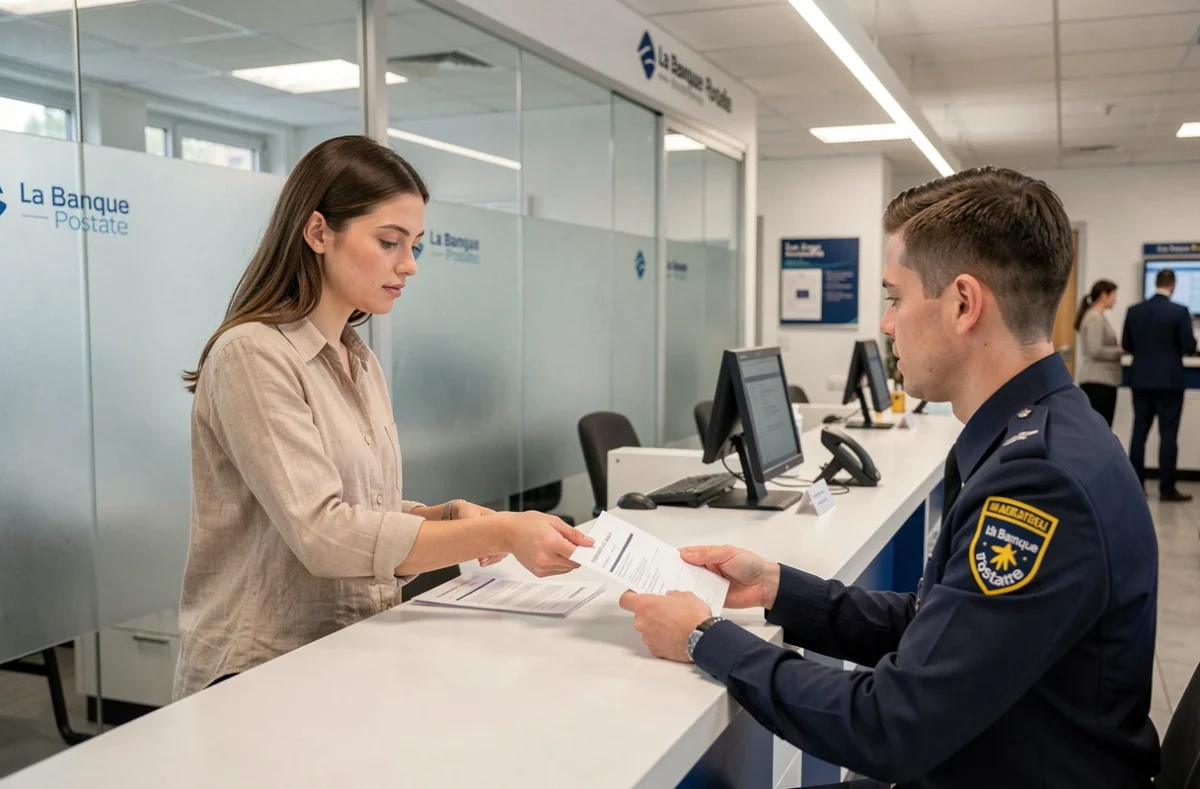
Prevention of unrecognized debits on La Banque Postale space
Several settings available in the app or online space help reduce the risk of fraudulent transfers. Activating real-time notifications for each outgoing transaction remains the first filter: it allows detecting a debit within seconds of its execution.
Regularly reviewing the list of registered beneficiaries is a second reflex. A beneficiary added without your knowledge, even without an immediate transfer, indicates a compromise of account access. In this case, immediately change the password and revoke active sessions takes precedence over any other action.
La Banque Postale never asks by phone to validate a transfer or to provide a code received by SMS. Any call of this type, even from a number that seems legitimate, should be hung up without further action. Calling the official number on the back of the bank card remains the only reliable method to verify that a contact is authentic.