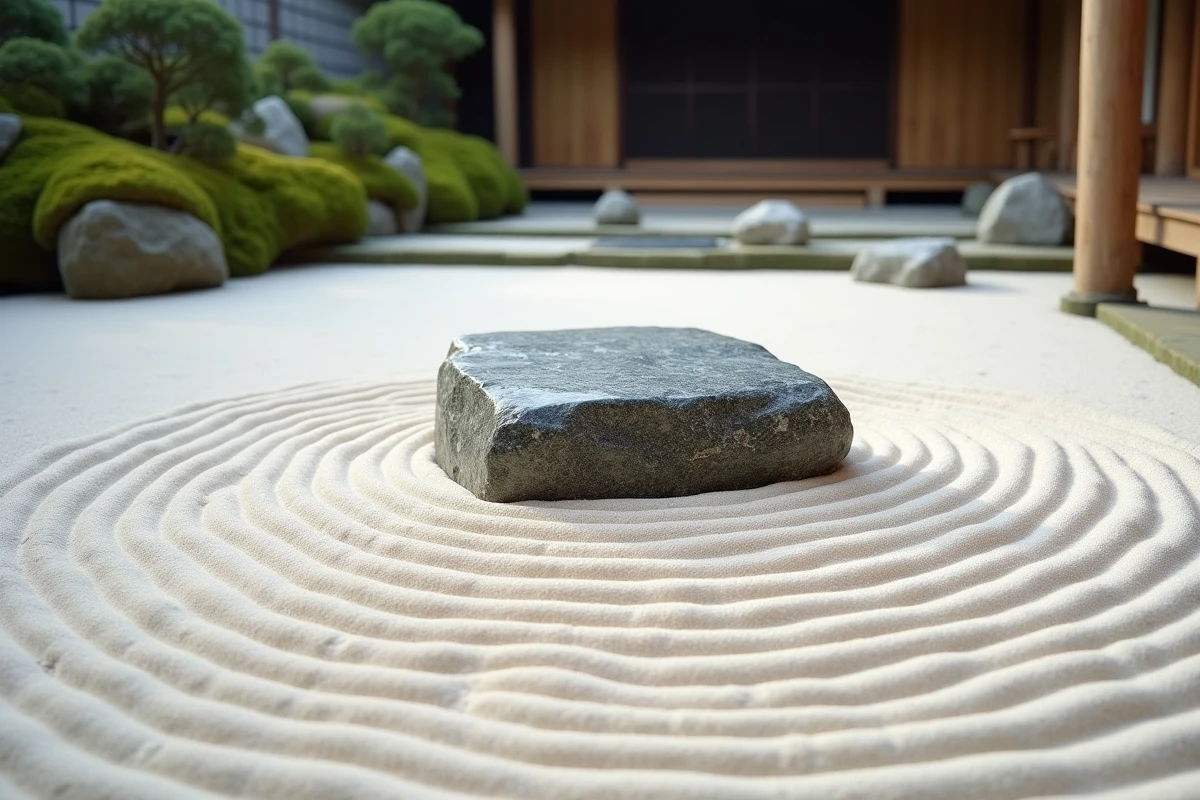
When you place Japanese stepping stones on a bed of fine sand, they sink at the first rain. The choice of sand in a Japanese garden is not just a matter of aesthetics: it is primarily a constraint of stability, drainage, and durability. Inappropriate sand compacts, turns green, or disperses in the wind within a few weeks.
Stability under Japanese stepping stones: the sand that is often overlooked first
Most guides focus on color or symbolism. In practice, the first issue is mechanical. If you lay slabs or stepping stones, the sand must support a load without giving way.
A round river sand rolls under pressure: the slabs move, and alignment is lost. To know which sand to use for a Japanese garden, we start by distinguishing grains by their shape and size, not by their hue.
A slightly angular sand compacts much better than rolled sand. Crushed quarry sand, with a grain size between 0 and 4 mm, offers a good compromise between compactness and drainage. Under Japanese stepping stones, it is sometimes mixed with a bit of draining gravel to prevent water from pooling on the surface. This technique provides a visually natural surface but is significantly more stable than conventional sand.
White quarry sand or crushed gravel: comparison for zen gardens
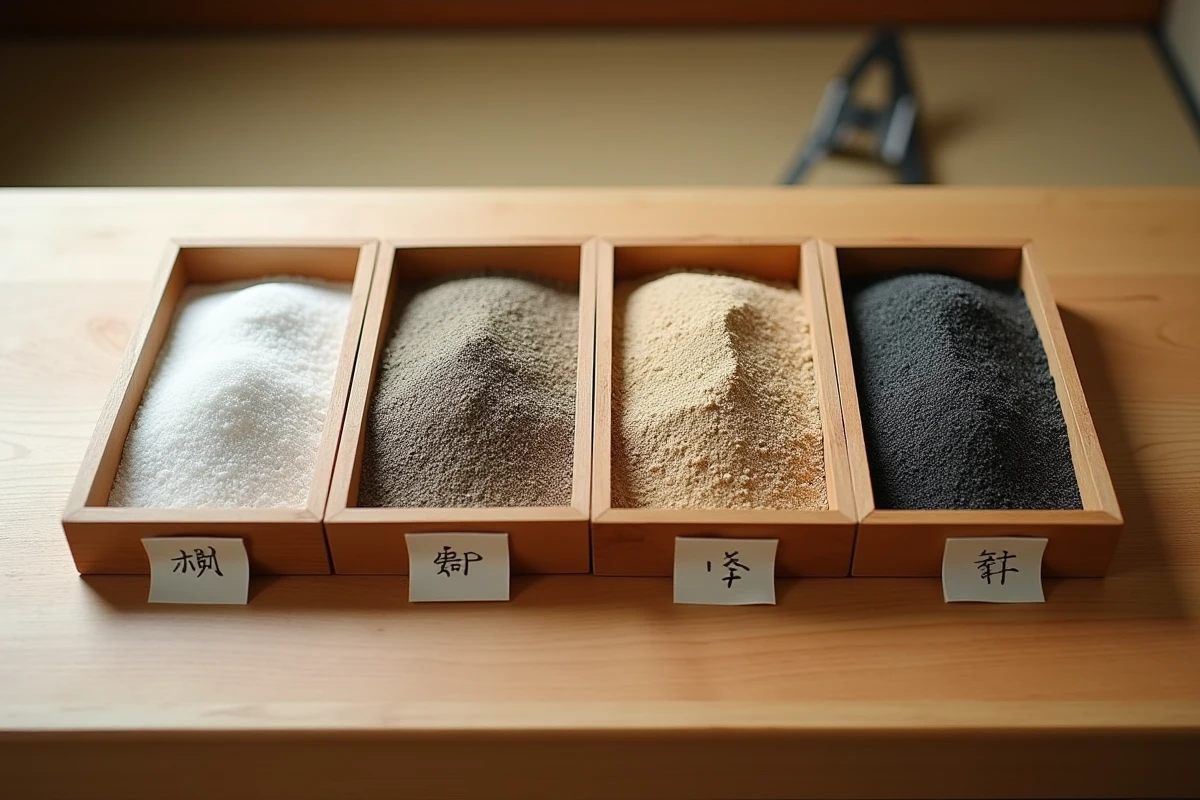
White quarry sand, often sold as “sandbox type” sand, gives a result very close to traditional karesansui. Its fine grain size and light color work particularly well on small surfaces, below a few square meters. For a small urban zen garden, it is the most accessible choice at garden centers or material suppliers.
Crushed gravel (size 6/10 or 4/8) is better suited for larger outdoor areas. It comes in light gray, cream, or yellow depending on regional quarries. Its main advantage: crushed gravel does not disperse in the wind, unlike fine sand exposed on a terrace or in a ventilated corridor.
What color really changes
Very light sand visually enlarges the space and enhances the contrast with dark stones and moss. Cream or ochre gravel integrates more easily into a mixed garden where minerals coexist with plants.
- Fine white sand: ideal for mini indoor zen gardens or wind-protected surfaces, very bright finish, easy pattern tracing with a rake
- Light gray crushed gravel (6/10): suitable for large outdoor spaces, stable, good drainage, limited maintenance
- Cream or yellow crushed gravel (4/8 or 6/12): warm tone that pairs well with beige-ochre rocks, good hold even without edging
Feedback varies on washed river sand: some appreciate its natural roundness, while others find that it quickly migrates out of raked areas. It is best reserved for purely decorative compositions without pedestrian traffic.
Grain size of sand for Japanese gardens: choose according to use
Grain size is the technical criterion that determines everything else. Sand that is too fine (below 1 mm) behaves like dust in dry weather and forms a hard crust after rain. A grain size between 2 and 5 mm offers the best balance for outdoor use.
For pattern tracing with a rake, the higher range (4-5 mm) creates more pronounced and readable grooves. For a softer and more uniform finish, you can go down to 2-3 mm, accepting more frequent maintenance.
Adapting the choice to the surface and climate
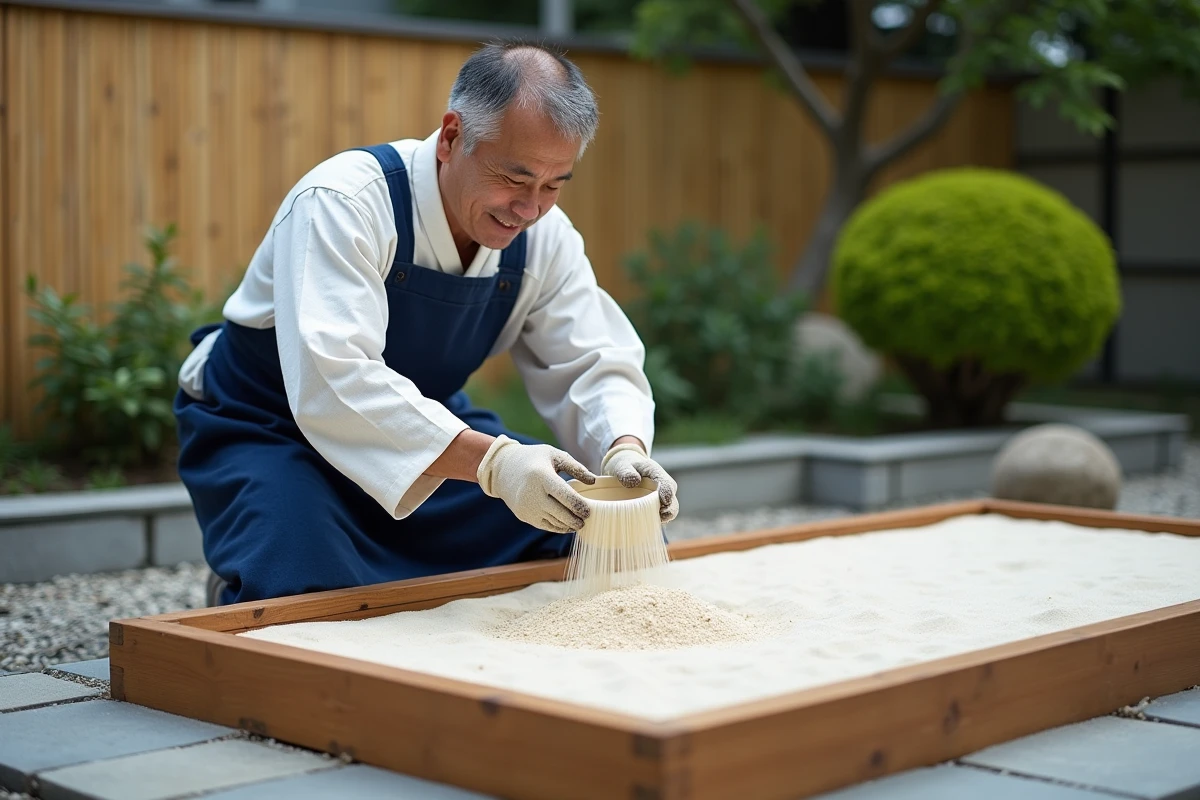
On a sheltered terrace or balcony, fine white sand works without particular constraints. In open ground, exposed to the elements, it is better to opt for a larger grain size and plan for a draining layer underneath (gravel, geotextile).
Combining fine sand and draining gravel reduces maintenance and limits weeds. This sand-gravel approach also responds to drought episodes: less surface vegetation to water, a dry garden that remains aesthetic all year round.
Maintenance of zen garden sand: what makes a difference daily
Regular raking serves more than just meditation. It prevents moss and algae from colonizing the surface, especially in humid or shaded areas. A weekly pass with a fine-toothed rake is sufficient for small areas.
Dead leaves are the main enemy of light sand. As they decompose, they stain the surface and nourish weed seeds. Removing plant debris before it decomposes avoids most greening problems.
- Placing a geotextile under the sand blocks the rise of weeds from the ground
- Reloading the sand layer once a year compensates for natural compaction and losses due to runoff
- Avoid locations under deciduous trees, or plan for a leaf blower in autumn
For a garden of a few square meters, completely renewing the sand every two or three years restores its initial shine without a significant investment. For crushed gravels, a simple rinse with a jet is usually sufficient.
The sand of a Japanese garden is chosen first with the hands, not with the eyes. Taking a sample, compacting it in the palm, checking that it does not flow between the fingers: this is the most reliable test before ordering several bags. The color will confirm the choice, not dictate it.