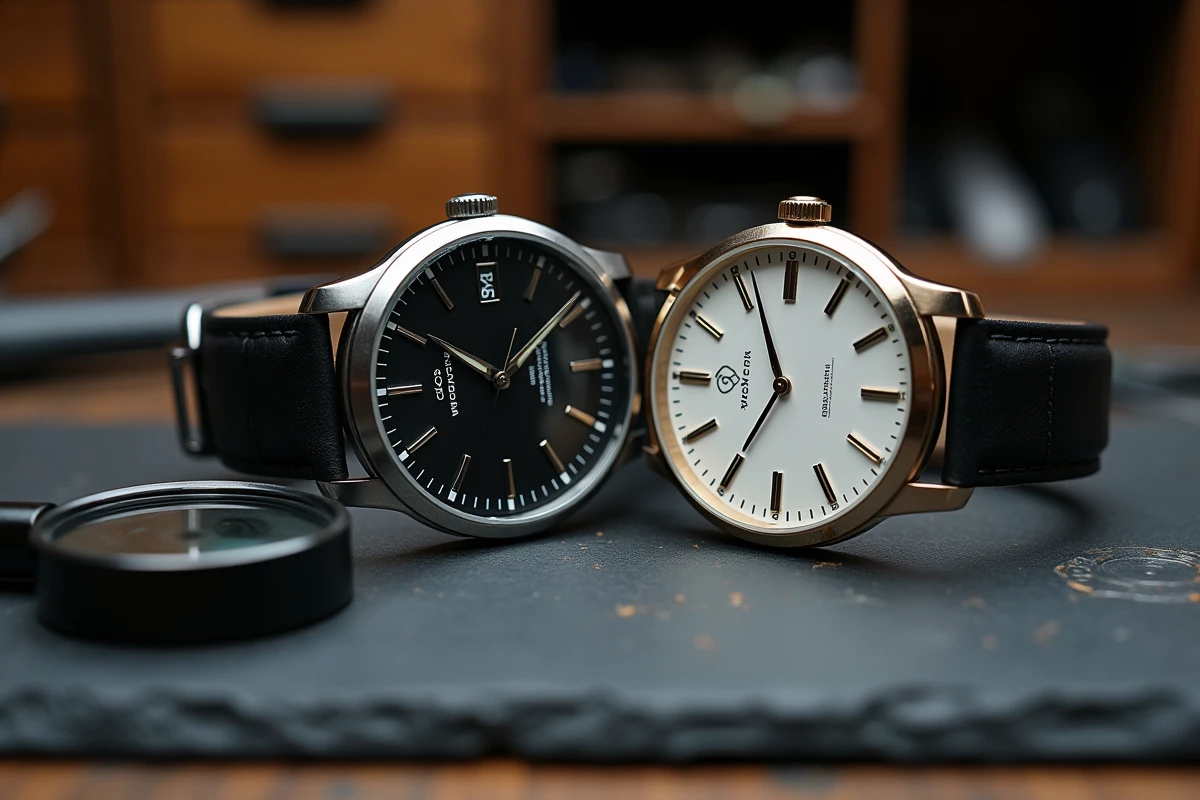
On general marketplaces, counterfeit Orient watches have been multiplying in recent years, concentrated on specific references: Kamasu, Mako III, and some Bambino. Identifying a genuine Orient watch requires cross-referencing several physical and documentary clues, not just a single isolated criterion. This article details the most discriminating checkpoints between an authentic model and a copy.
Comparison table: authentic Orient versus a common counterfeit
The differences between a real Orient and a replica are not always obvious in a marketplace photo. The table below gathers the observable discrepancies on the most copied models.
| Criterion | Authentic Orient | Typical Counterfeit |
|---|---|---|
| Movement | In-house caliber (F6722, series 46), signed Orient rotor | Generic Chinese movement, rotor without marking or blurry marking |
| Dial | Orient logo applied or printed clearly, indexes aligned to the millimeter | Slightly misaligned logo, approximate font, uneven indexes |
| Case back | Sharp laser engraving with model reference, serial number, mention “Japan Mov’t” or “Made in Japan” | Shallow engraving, different font, sometimes absence of serial number |
| Crown | Fluid screwing, Orient logo on the side (depending on model) | Mechanical play, rough finish, logo absent or poorly centered |
| Glass | Mineral or sapphire glass depending on the range, even reflections | Low-quality plastic or mineral glass, irregular reflections |
| Bracelet | Fitted links, signed deployant buckle, no lateral play | Light links, unsigned buckle, noticeable play |
This table covers the most frequent discrepancies. Some points deserve a more in-depth examination, detailed in the following sections.
To complement this grid, you will find more information on Flash Wave with comparative visuals and purchasing advice tailored to each Orient range.

Orient Movement: the signed rotor as an authenticity marker
Orient manufactures its own mechanical calibers, which is a notable feature in this price range. On an authentic model, the rotor bears the Orient signature engraved or printed, visible through the transparent case back (present on most recent references).
Counterfeits use generic movements, often of Chinese origin, with a smooth rotor or one bearing markings unrelated to Orient. The difference is also noticeable to the touch: the manual winding of an Orient caliber offers progressive and consistent resistance, while a copy movement often produces a jerky feeling or an abnormally loud ratchet noise.
Power reserve and movement behavior
A recurring testimony on enthusiast forums concerns the power reserve. Some counterfeits display fanciful indications on the dial (claimed power reserve unrelated to the actual caliber). A user on the ForumàMontres reported having bought a supposed Orient in Vietnam with a claimed power reserve of eight days, which corresponds to no existing Orient caliber. This type of technical inconsistency is an immediate red flag.
Reference and official Orient catalog: a concrete verification tool
The official Orient France website (orientwatch.fr, managed by Epson) allows for cross-referencing exact references, product families, colors, and collection codes. This online catalog serves as an often underutilized indirect authentication tool.
- A model presented as “limited edition” or “Europe version” but unavailable in the official catalog or collection archives is a strong warning signal
- The consistency between the reference code engraved on the case back and the corresponding product sheet on the official site must be verified before any purchase
- The colors and dial/bracelet combinations offered by Orient are precisely documented: a combination absent from the catalog likely does not exist
A model not found on the official Orient site should be considered suspicious unless additional documentary evidence is provided by the seller.

Orient Counterfeits on Marketplace: the most targeted models
Not all Orient references are copied with the same frequency. Enthusiast communities (subreddits r/OrientWatches, r/JapaneseWatches) have reported a concentration of counterfeits on three specific families in recent years.
The Kamasu and Mako III top the list of counterfeited models, followed by certain variations of the Bambino. These references combine high popularity and moderate selling prices, making them attractive to counterfeiters: the cost-to-manufacturing ratio of a copy and the resale price remains sufficiently profitable.
Risky sales channels
Third-party sellers on Amazon, AliExpress, or Wish represent the channels where the risk of Orient counterfeits is highest. In contrast, authorized resellers listed on the official Orient site and physical watch shops offer reliable traceability.
- Check that the seller is identified as an authorized Orient dealer, not just “sold by” a third party on a marketplace
- A price significantly lower than the official catalog price, without justification (announced clearance, documented discontinued model), should raise alarms
- The absence of an international Orient warranty card or a certificate in an unusual format constitutes an additional clue
Documents and Orient warranty certificate: what to demand
An authentic Orient comes with an international warranty card and, depending on the point of sale, an invoice mentioning the exact model reference. The warranty card bears a number consistent with the case back, and the format of this document is standardized by Epson.
Counterfeits sometimes include a certificate, but it often presents anomalies: poor quality paper, different font, absence of serial number, or a number that does not correspond to any known reference. Comparing with photos of authentic certificates shared by collectors on specialized forums allows for quick identification of these discrepancies.
The cross-referencing of the number engraved on the back of the case, the warranty card, and the reference listed in the official catalog remains the most reliable method. When these three elements match, the probability of authenticity is very high. A single missing or inconsistent element is enough to warrant a thorough verification before finalizing a purchase.